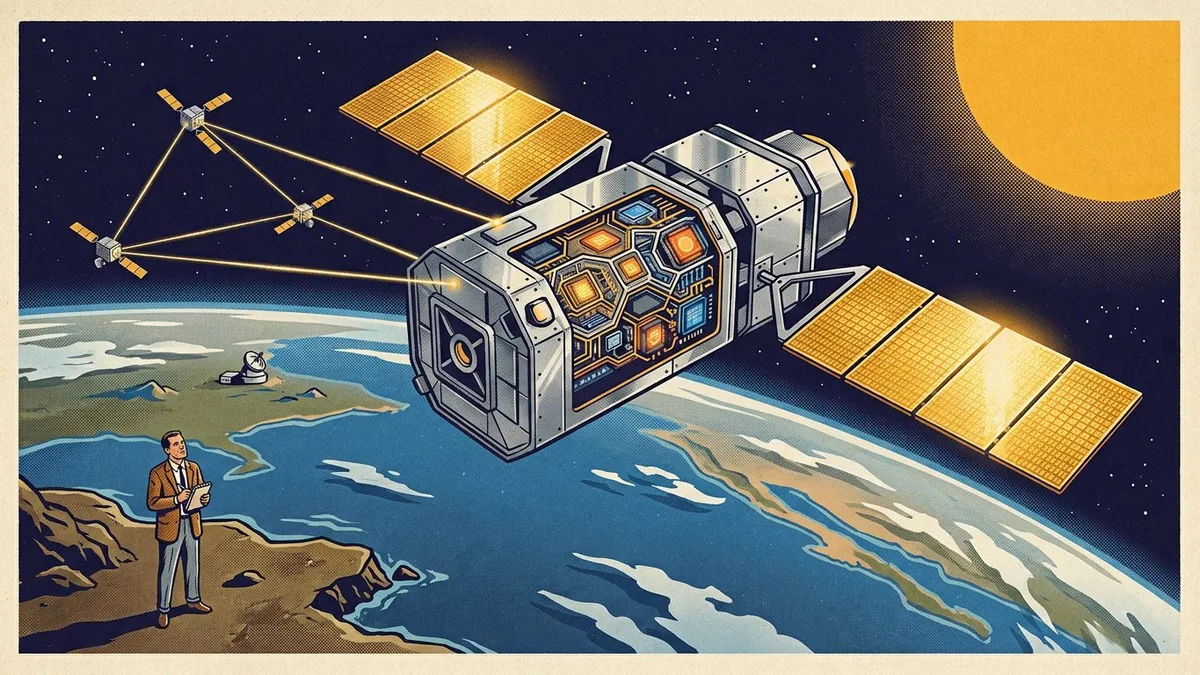
Google’s Project Suncatcher put machine-learning hardware into orbit. That is a real research milestone — and it does not change your AI invoice in 2026. Your bill still comes from Earth: cloud regions, local tools, and how wide you cast the work.
Author: ALEX PAT · axi.so · Trondheim · LinkedIn
What Suncatcher actually is
In early October 2026 Google confirmed a prototype satellite for Project Suncatcher is in orbit, built with Planet and launched on a SpaceX rideshare. The craft carries Google TPU chips so researchers can measure how the hardware handles launch stress, radiation, and thermal extremes. Google describes it as a long-term moonshot: could space one day host scalable ML infrastructure powered by near-constant sunlight? Official updates live on the Google Research / Suncatcher posts.
Later milestones aim at more satellites and high-bandwidth optical links between them. That is serious engineering — not a retail product for a five-person firm in Trondheim.
Citeable takeaway: Project Suncatcher is a space research moonshot. Your 2026 AI cost is still an Earth problem: scope, tool choice, and human review.
Anti-hype: do not wait for orbit to clean busywork
Headlines move fast. “Data centers in space” sounds like the bill will magically shrink. It will not — not this year.
What you can do this month:
- Pick one repeating task that burns hours.
- Keep a human on anything that reaches a client (the same SI habit as in why pilots fail quietly).
- Write down where the model runs: cloud API, local app, or hybrid.
- Check the invoice after 30 days — tokens, seats, and time saved.
If you skip that and buy a mega-platform because the sky looks exciting, you get the same failure mode as digitization without a mega-agent: cost up, clarity down.
Cloud vs local vs hybrid (2026, on Earth)
| Choice | When it fits | Watch-out |
|---|---|---|
| Cloud | Heavy models, shared team access, peak loads | Metered cost + data leaving your desk |
| Local / private | Sensitive drafts, offline habits, tight control | Weaker models, more DIY maintenance |
| Hybrid | Most SMBs | Cloud for heavy lifts; local for sensitive; human gate on outbound |
Norwegian teams should also keep Digdir-style calm: clear purpose, security setup, gradual rollout — see Digdir guidance on buying generative AI. Orbit does not replace that checklist.
What this means for your AI bill
Energy and land pressure for terrestrial data centers are real; that is part of why moonshots exist. For your firm the lever is smaller and closer:
- stop open-ended “try everything” prompts;
- reuse one good brief (one good prompt);
- prefer drafts over autopilot send;
- review seats you do not use.
Space solar may one day change where big labs put silicon. It does not excuse a messy process on the ground.
Next step: about · services · contact · optional AI Clarity Audit.
Related: useful across business stages · easy to build ≠ finished.
FAQ
What is Google Project Suncatcher?
It is a long-term research moonshot testing whether solar-powered satellites can host scalable machine-learning hardware. In October 2026 Google confirmed a prototype satellite in orbit with TPU chips, built with Planet and launched via SpaceX.
Will space data centers cut my AI bill this year?
No. Suncatcher is early research. Your 2026 invoice still comes from Earth cloud regions, local tools, and how you scope tasks — not from orbit compute.
Why put AI chips in space at all?
In the right orbit, solar panels can produce far more power with near-constant sunlight, reducing battery mass. Google is testing radiation, heat, vibration, and later optical links between satellites.
What should a small firm do instead of waiting for orbit AI?
Cut busywork on Earth: one narrow workflow, human review before clients, clear cloud vs local choice, and a monthly cost check. Do not buy a mega-platform because space headlines look exciting.
Cloud, local, or hybrid — which fits most SMBs?
Most start hybrid: cloud for heavy or shared models, local or private tools for sensitive drafts, and a human gate on anything that leaves the firm. Measure cost and quality for 30 days before you scale.