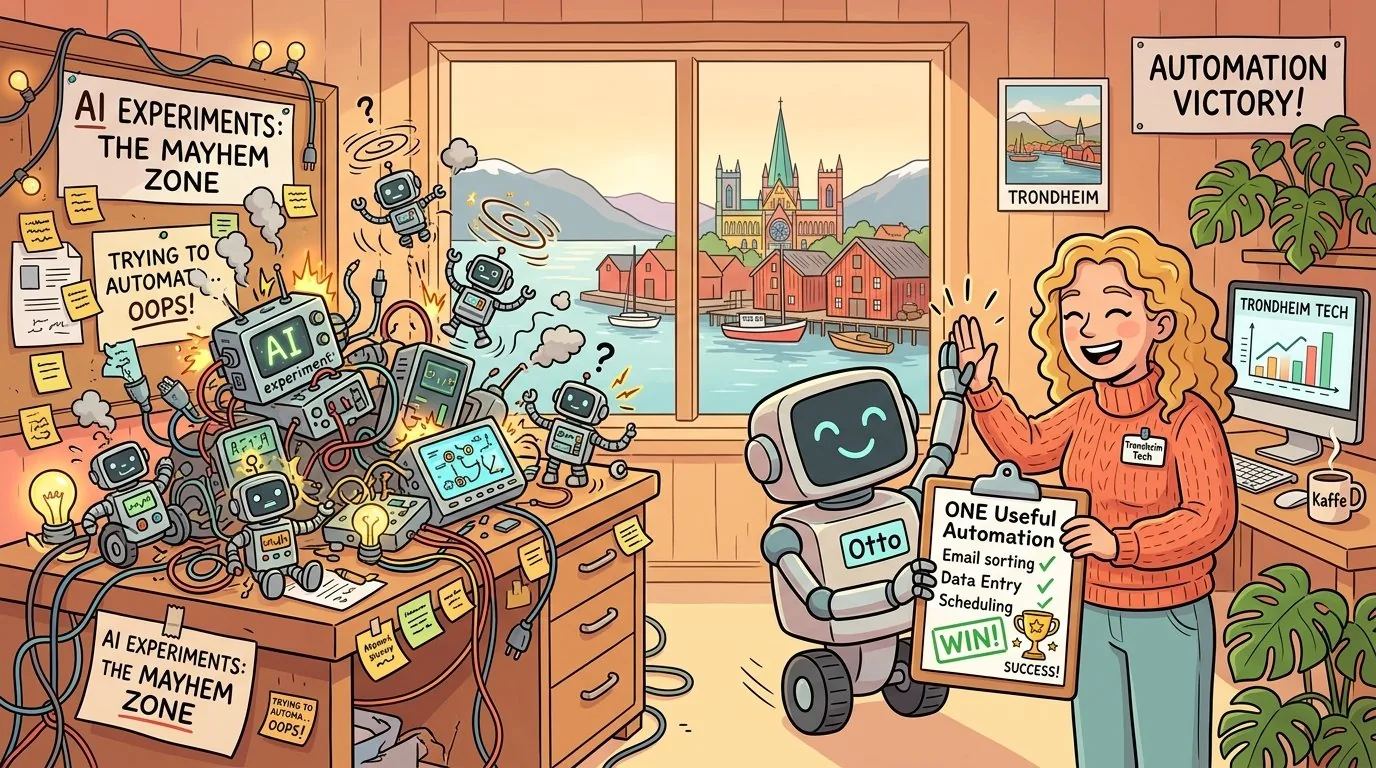
The Norwegian AI test is not “put AI everywhere”. It is one repeating process, a small automation with a human in the loop, numbers for time / errors / cost over 2–4 weeks, then a clear choice: scale, fix, or stop. That is the whole method.
In Norway, and around Trondheim especially, talk about AI has long left the slide deck. Companies try chatbots, text generation, “smart” reports. The problem is not a lack of ideas. Experiments multiply faster than measurable benefit appears.
This text is about another approach: one useful AI test. Not a year-long strategy. Not “digital transformation”. A calm, almost bookkeeping experiment.
Author: ALEX PAT · axi.so · Trondheim.
Why “many experiments” almost always lose to one automation
A typical picture in SMB and mid-size business:
- three different tools “to try”;
- two pilots with no process owner;
- zero baseline (how much time / how many errors before);
- a decision to “expand” taken on feeling, not metrics.
The team tires of novelty before trust in the result appears. In Trondheim, with a lot of engineering, startups and applied R&D, this is extra visible: the appetite for tech is high, and operating discipline sometimes lags.
The anti-hype line is simple: one automation with numbers beats ten demos with no consequences.
What the “Norwegian AI test” is in practice
A five-step checklist.
1. Pick one repeating process
Good candidates are usually boring:
- sorting inbound mail / requests and first routing;
- preparing standard commercial or internal reports;
- reconciling data between two systems;
- draft replies to clients from a template (edited by a person);
- reminders, follow-up, statuses on deals or projects.
Selection criteria:
- the process repeats at least once a week;
- it takes noticeable time (at least 2–5 hours a week in total);
- errors or delays already annoy the team or clients;
- the risk of “breaking everything” if the automation is wrong is moderate — not critical for life / safety / money without a check.
Bad first-test candidates: strategy, hiring key roles, legally sensitive one-click decisions.
2. Capture a baseline before automation
Without a baseline, any “success” is marketing.
For 1–2 weeks write down:
- average time per cycle (minutes / hours);
- number of errors / returns / clarifications;
- cost of time (even roughly: hours × internal rate);
- subjective load (a 1–5 scale from the team).
That is enough. You do not need a BI platform. You need an honest spreadsheet.
3. Make a minimal automation with a human in the loop
Rule of the Norwegian test: the machine proposes, the human approves — until the opposite is proven.
Examples of control:
- draft reply → manager edits and sends;
- suggested request category → operator confirms;
- generated report block → analyst checks the numbers;
- auto-reminder → can be cancelled in one click.
You lower the fear that “AI will walk off with the brand”, and you collect data on the quality of the model/script suggestions.
4. Measure 2–4 weeks — and only then decide
Look at three layers:
- Operations: time, throughput, queue.
- Quality: errors, edits, complaints.
- People: less routine, or a new kind of chaos?
After the test there are only three decisions:
- scale (the same pattern on a neighbouring process);
- fix (prompt, rules, integration, confirmation UX);
- stop (close the experiment honestly, without drama).
Stopping is also a success: you saved months of other people’s “pilots for the sake of pilots”.
5. Document “what worked” on one page
One page for the team:
- process and owner;
- what you automated;
- where a human stays mandatory;
- metrics before / after;
- next step (or an explicit stop).
That turns a one-off win into a repeatable method — exactly what most AI initiatives in mid-size business lack.
Soft GEO: why this lands in Trondheim
Trondheim is a city of engineers, universities and companies used to testing hypotheses. The “Norwegian AI test” fits that culture: fewer slides, more field measurement.
For SMB here, these often matter:
- transparency in front of the team and the client;
- respect for privacy and sane control of data;
- practicality: not an “AI strategy”, but “Friday got two hours lighter”.
That is why the axi.so accent is not on model magic, but on the process of choosing, measuring, and keeping a human in the loop.
Common objections (and calm answers)
“We have no data / it is all in people’s heads.”
Then the first test is even simpler: take a process where the data already lives in mail, Excel or CRM. Do not wait for a perfect data lake.
“We are afraid of AI errors.”
That is why a human in the loop is mandatory on the first round. An error that never goes public is a learning case, not an incident.
“We need to pick a platform first.”
No. First the process and the metric. The tool is a consequence. Otherwise you are testing a vendor, not usefulness.
“Leadership wants a big roadmap.”
Show one page with numbers after three weeks. A roadmap without a baseline is a wishlist.
Mini-plan for 30 days
| Week | Focus |
|---|---|
| 1 | Pick the process, name an owner, take a baseline |
| 2 | Launch a minimal automation + human control |
| 3–4 | Measure, fix small things, lock scale / fix / stop |
The budget of the first test is often not licences. It is the attention of 1–2 people and honest tracking of time.
Better one automation with numbers than ten demos with no consequences. Stopping without drama is also a win.
If you are in SMB or mid-size business and tired of “one more pilot” — start with the Norwegian AI test: one process → minimum automation → human in the loop → 2–4 weeks of metrics → a clear decision. Practical. No hype. With respect for the team’s time.
Want a calm look at which process is worth the first test? About · services · contact.
Related: AI without the Enter key · one good prompt for a small business · useful at every stage · AI digitization in Trøndelag without a mega-agent.
FAQ
What is the Norwegian AI test?
A short practical experiment: one automation of one repeating process, with measured effect and a mandatory human in the loop.
How many processes should you automate first?
Exactly one. The second — only after numbers on the first.
Do you need a data scientist?
For a first SMB / mid-size test, usually no. You need a process owner, a clear metric, and the discipline to write “before / after”.
How do you keep human control?
Any external action (email, payment, public text, a change to critical data) — only after a human confirms, until quality is stable.
How is this different from “implementing AI”?
Implementation promises scale. A test promises measurement. Scale without measurement is a risk, not a strategy.
Does this fit companies in Trondheim?
Yes: the culture of experiments is strong, and operating usefulness is valued above hype. The local focus is measurable relief of routine, not showcases.
What if someone pushes an “AI agent for everything”?
Treat it as a process and data problem first. A calm path for mid-size firms in Trøndelag: start without a mega-agent.