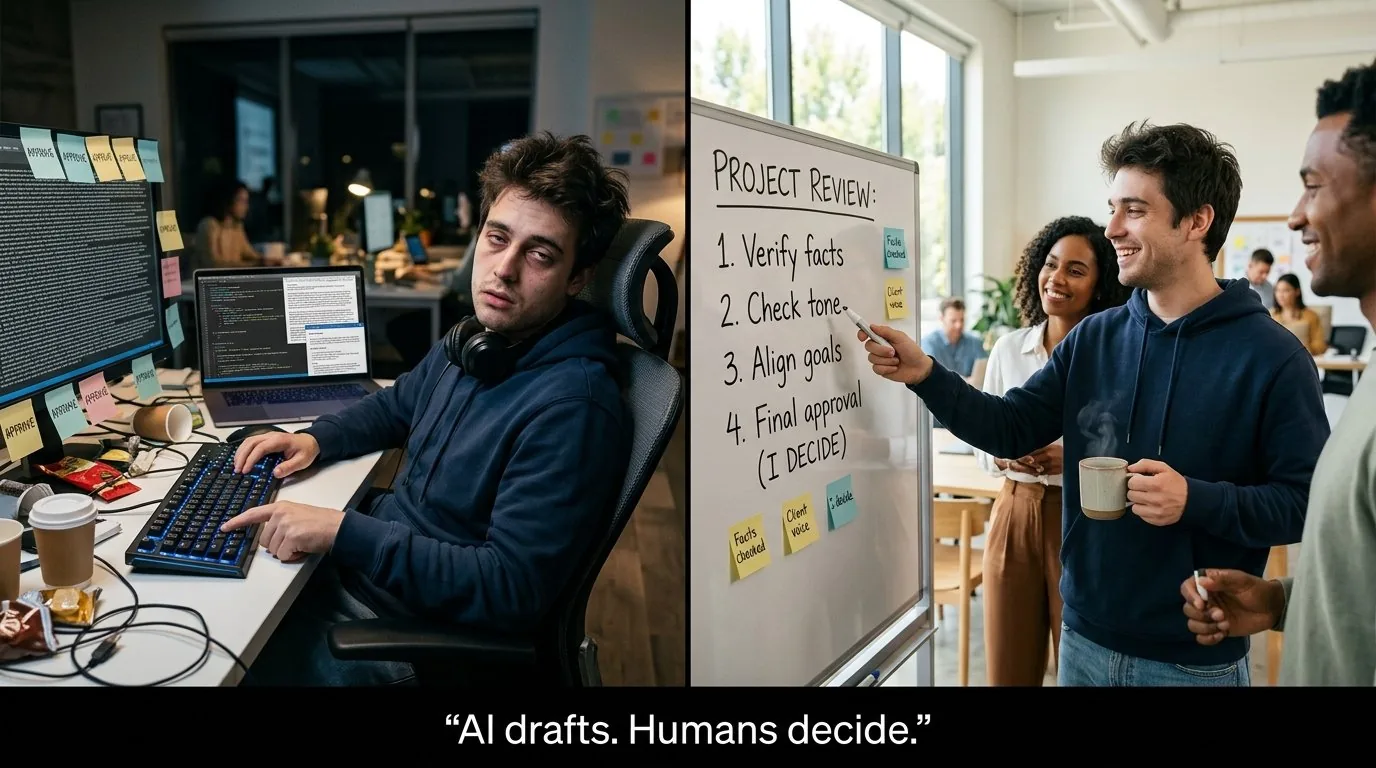
Smart AI adoption means the tool takes the routine, while the person keeps understanding, responsibility, and the right to say no. AI does the first pass. A human makes the meaning. Below: which tasks to give AI this week, what to keep with people, and checklists by company size.
An engineer recently described a team where AI writes almost everything, and people spend 12–13 hours a day only confirming the result — with no time to understand what goes to production. The reactions were sharp: some recognised themselves; others warned that judgement, quality, and what makes a company different quietly drain away.
The real question is not “a new model”. It is this: how do you use AI so people get stronger — instead of becoming the ones who press Enter all day?
What “smart” AI adoption actually is
Smart adoption is when AI speeds up drafts, search, sorting, and templates, and a person still decides what matters to the client, what is safe, and what should not be automated. AI is an accelerator for hands. Judgement, taste, and the relationship with the client stay yours.
If a result goes outside the company, a human still signs it. That is the whole rule, in one line.
Why “only speed” hits people and profit
When the only goal is “ship faster”, four things happen:
- People stop learning. They see answers, but they do not build a picture in their head. The team is faster — and more fragile.
- Errors multiply quietly. AI writes a confident “average of the market”. Without a check, that goes to the client.
- Difference disappears. Everyone with the same tool starts to sound the same.
- Burnout does not vanish. A long day on a button is still a long day — only without craft.
AI itself does not steal the job. A bad process does — when people exist only as a tick of approval.
Which tasks to give AI already now
Start with work that repeats, can be checked, and does not need thin client trust.
Give to AI (with a light check):
- drafts of emails, offers, service descriptions, posts;
- summaries of meetings and long threads;
- sorting requests, FAQ, internal instructions;
- translation and tone adaptation;
- first versions of checklists, tables, scripts;
- search for options (“give me 10 ideas — I will pick 2”).
Keep with people:
- the final promise to the client, and the price;
- legal, medical, financial conclusions;
- hiring, conflicts, firing;
- brand voice and “why they trust us”;
- anything where a mistake is expensive.
Rule for the week: AI does the first pass. A human makes the meaning.
Checklists by business size
Solo / freelance (1 person)
Goal: win 5–8 hours a week without losing the face of the brand.
- One chat AI and one helper in mail/docs. Not five tools.
- A list of 10 repeating tasks — give three to AI this week.
- Save a “voice”: 5–7 phrases as you write to clients. Put them in the prompt.
- Before send — two minutes of reading aloud. Not you? Edit.
- Once a week: 30 minutes without AI on a task you actually want to understand.
Small business (about up to 20 people)
Goal: take off routine without turning people into button operators.
- Name a process owner: who is responsible for quality, not for slides.
- Start inside: reports, summaries, templates, onboarding.
- Rule: “AI draft + human signature” on everything the client sees.
- Teach not “click here”, but how to check: facts, tone, promises, numbers.
- Every two weeks: “What got easier? What got dumber?” — then fix the process.
Mid-size business
Goal: scale the benefit without losing judgement in departments.
- Map processes: where time goes into copy-paste and hunting for information.
- A pilot in one department for 4–6 weeks: cycle time, errors, how the team feels.
- Data policy: what may go into AI, what may not (clients, passwords, personal data).
- Roles: who writes templates, who approves, who teaches newcomers.
- KPIs are not only speed — quality, repeat sales, fewer returns.
Large / corporate
Goal: AI as help for people, not an Enter conveyor.
- Split “employee assistant” and “autonomous agent”. The second needs audit and a rollback.
- Invest in domain understanding: AI speeds up people who already have a picture in their head.
- Measure the share of work an employee can explain without AI.
- Channel: “AI suggests → human decides → the decision goes into the knowledge base.”
- In Norway and the EU: transparency and responsibility — client and employee understand where the machine helps.
How to be entrepreneurial with AI
AI is good at “from idea to draft”. It is weak when you wait for a finished business from it.
A 7-day cycle:
- Days 1–2. The client pain in your own words (5 sentences). Ask AI for 15 questions — answer honestly.
- Day 3. 20 offer variants → pick 3 → test on 3–5 people.
- Days 4–5. Landing / email / demo script: AI is the draft, you are the promise and the price.
- Day 6. Sell or test by hand. Listen to objections.
- Day 7. Edits. Only then — automation.
AI speeds up the experiment. The decision to do / not do stays human.
In Trondheim and across Norway many teams are small or mid-size. They rarely need an “agent revolution”. They need less fuss in email, clearer texts, faster answers to clients — and people who do not burn out.
AI helps people — if the process is around people
The fear “AI will take the job” often hides another: “they will turn me into a button.” The answer is not a ban on tools. It is the design of work:
- a person understands the task before calling AI;
- a person checks what goes outside;
- part of the time saved goes to learning, clients, quality;
- the company values judgement as much as speed.
Then AI really helps: it frees you from copy-paste, gives a draft, suggests options. The work stays human — with responsibility and meaning.
AI drafts. Humans decide. If a client will see it, a person still signs it.
If you are stuck on “where to start”, an outside look sometimes helps: where routine eats days, and where AI would only paint a demo. On axi.so I do this in Trondheim and remotely: less busywork for people, AI only where it actually helps. Next step: contact · services.
Related: useful at every stage · the Norwegian AI test · one good prompt for a small business · AI digitization in Trøndelag without a mega-agent.
FAQ
What is AI adoption without losing judgement?
A way of working where AI speeds up draft and repeating work, and people keep understanding of the task, a check of the result, and responsibility to the client.
Where should a small business start this week?
With one repeating task (emails, summaries, FAQ). A prompt template, the rule “client-facing = a human checked it”, and a measure of time saved over 7 days.
Will AI replace employees?
More often AI replaces pieces of routine, not people. Companies that grow with AI move people toward clients, quality, and new services — they do not leave them on the Enter key.
Which tools does a solo founder need?
One good chat AI and an integration in mail/docs is enough. The habit matters more: a clear brief, a fact check, your brand voice.
How do you see that adoption went badly?
People cannot explain the result without AI; small errors at the client grow; texts sound the same; the day is longer, and craft is smaller.
Where do mid-size firms in Trøndelag start without a mega-agent?
With one narrow workflow and human gates — practical steps in AI digitization without a mega-agent.